
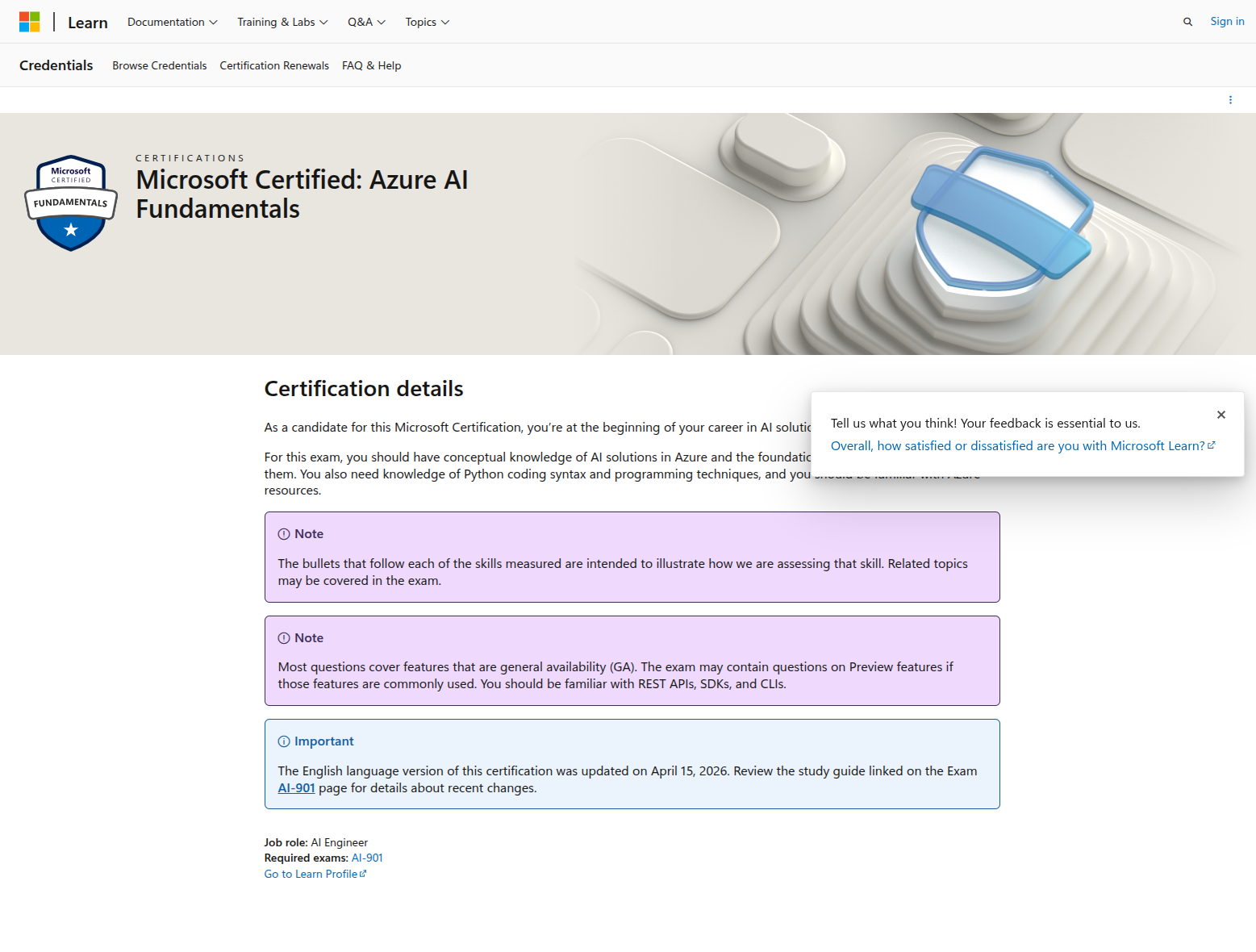
Yes, if you’re a Microsoft-first desktop engineer who wants a recognized baseline AI credential, but take AI-901, not AI-900. Microsoft retired AI-900 on June 30, 2026 and replaced it with AI-901 for the Azure AI Fundamentals certification. The next step most guides recommend, AI-102, also retired on June 30, 2026. The active associate-level path now is AI-103.
Quick verdict
| Current exam | AI-901: Microsoft Azure AI Fundamentals |
| Retired | AI-900 (June 30, 2026) |
| Level | Fundamentals |
| Best for | Microsoft-heavy desktop engineers and sysadmins who want a baseline AI credential |
| Biggest change | Over half the exam is now hands-on-style Microsoft Foundry work |
| Next step | AI-103 (Azure AI Apps and Agents Developer Associate), if you’ll build AI apps |
Official pages: certification, AI-901 exam, AI-901 study guide.
What changed from AI-900 to AI-901
Microsoft’s AI-900 page now says the certification requirements changed: AI-900 retired on June 30, 2026, and candidates must pass AI-901. The English version of the certification was updated on April 15, 2026.
If you studied from an AI-900 guide, the outline has changed. The old AI-900 domains were workload-by-workload: machine learning, computer vision, NLP, and generative AI. AI-901 has two domains:
| Domain (skills as of April 15, 2026) | Weight |
|---|---|
| Identify AI concepts and capabilities | 40–45% |
| Implement AI solutions by using Microsoft Foundry | 55–60% |
The second domain includes deploying a model and using it in the Foundry portal, creating a lightweight chat client with the Foundry SDK, creating and testing a single-agent solution, building lightweight text, speech, and vision apps, and extracting information with Azure Content Understanding. The first covers responsible AI principles, how generative AI models work, choosing models and deployment options, and recognizing common AI workloads, including agentic AI.
Microsoft says candidates need conceptual knowledge of AI solutions in Azure, foundational technical skills, knowledge of Python syntax, and familiarity with Azure resources. This isn’t a PowerShell-only exam.
How to prepare
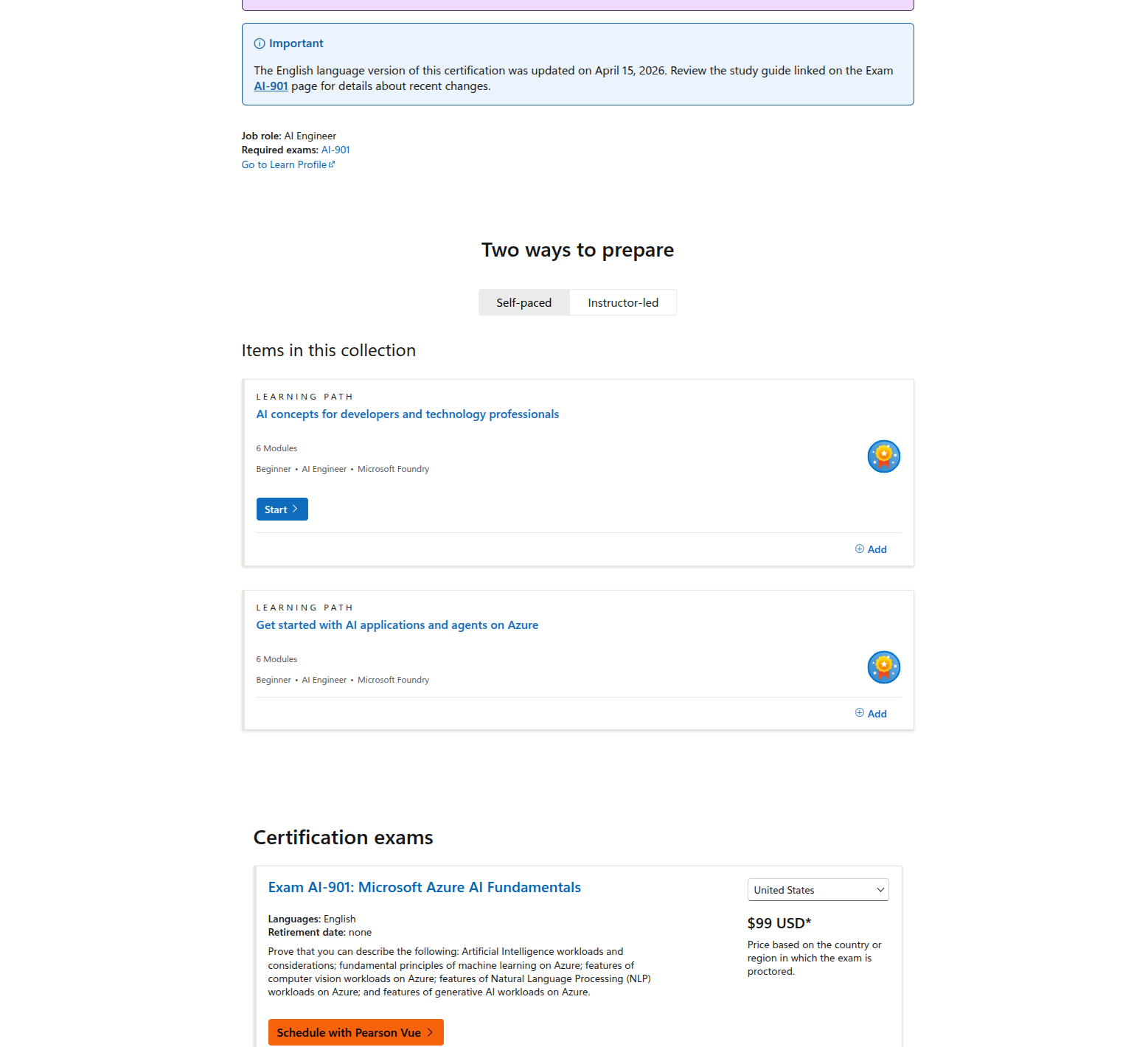
As of October 19, 2026, the certification page says learning paths aren’t yet available for this certification. The exam page lists the course Introduction to AI in Azure (AI-901T00), the study guide, the exam sandbox, and a practice assessment on AI Skills Navigator. Microsoft prices the exam by the country or region where it’s proctored.
Why desktop engineers should care
You’ll be asked whether a Copilot-style feature is useful, whether an AI workflow touches sensitive data, and whether a vendor’s “AI” pitch holds up. AI-901’s responsible AI and model-selection topics map to exactly those questions, and the Foundry tasks give you enough hands-on context to judge internal AI tool requests.
It won’t prove you can ship production AI on its own. For that, look at an Applied Skills credential or the associate path below.
Worth it if you’re Microsoft-heavy (Intune, Entra, Microsoft 365), moving toward Azure-adjacent work, or need AI vocabulary for internal projects.
Skip or delay if you still need core PowerShell, Intune, or troubleshooting depth, you work in a non-Microsoft environment, or you want lab-based proof first. See Microsoft Applied Skills: Build a generative AI chat app.
What to take next
AI-102 (Azure AI Engineer Associate) retired on June 30, 2026, and its renewal assessment is retired too. The active associate-level Azure AI developer certification is Microsoft Certified: Azure AI Apps and Agents Developer Associate, earned with Exam AI-103: Developing AI Apps and Agents on Azure.
One caveat: Microsoft Learn doesn’t state in plain words that AI-103 replaces AI-102. Its retirement notice links to a Tech Community post for details. AI-103 covers the same domains, weighted toward generative AI and agents. Details are in AI-102 retired: is AI-103 worth it for Microsoft engineers?.
For a self-paced Coursera route with no proctored exam, see Microsoft Generative AI Engineering certificate: worth it?.
How it compares
- AWS Certified AI Practitioner (AIF-C01): also foundational, and a better fit if your role is moving toward AWS. See AWS Certified AI Practitioner for IT pros.
- Google Cloud Generative AI Leader: aimed at business-level gen AI knowledge. See Google Cloud Generative AI Leader: worth it?.
- Coursera programs: more depth and portfolio work, but a course certificate rather than a proctored exam credential.
For a Microsoft-first desktop engineer, AI-901 is the most direct Microsoft AI baseline.
FAQ
Is AI-900 still available?
No. Microsoft retired AI-900 on June 30, 2026. To earn Azure AI Fundamentals you now pass AI-901.
Is my existing AI-900 certification still valid?
The retirement means you can no longer take the AI-900 exam. Yes. Microsoft isn’t retiring the Azure AI Fundamentals certification itself, and if you already hold it, no action is required. Microsoft Learn also states that Fundamentals certifications do not expire, so your existing credential stays valid.
Is AI-901 hands-on?
More than AI-900 was. Microsoft weights Foundry implementation tasks at 55–60% of the exam, and lists Python knowledge as a prerequisite.
Should I take AI-102 after AI-901?
You can’t. AI-102 retired on June 30, 2026. The active associate path is AI-103 (Azure AI Apps and Agents Developer Associate).
Is AI-901 better than a Coursera certificate?
For a recognized exam credential, yes. For learning depth and portfolio projects, Coursera programs often go further.
Sources
- Azure AI Fundamentals certification, Microsoft Learn (checked October 19, 2026)
- Exam AI-901 and AI-901 study guide, Microsoft Learn
- Exam AI-900, Microsoft Learn (retirement notice)
- Exam and assessment lab retirement, Microsoft Learn
- Azure AI Apps and Agents Developer Associate (AI-103), Microsoft Learn