
PECB ISO/IEC 42001 Lead Implementer: Is the AI Governance Credential Worth It?
If your organization is deploying AI but has no dependable way to track ownership, risk decisions, monitoring, or corrective actions, the gap is not another model-development course. It is governance that works across the lifecycle. The PECB Certified ISO/IEC 42001 Lead Implementer credential is aimed at professionals planning and implementing an Artificial Intelligence Management System (AIMS) against the ISO/IEC 42001 standard.
This is a specialized governance and management-system credential—not a hands-on machine-learning engineering qualification. It is most relevant to IT, security, risk, compliance, and AI program professionals who expect to help an organization implement, operate, or improve an AIMS.
Quick verdict
| Category | Assessment |
|---|---|
| Credential | PECB Certified ISO/IEC 42001 Lead Implementer |
| Standard | ISO/IEC 42001:2023, Artificial intelligence — Management system |
| Exam | Three hours; PECB lists six competency domains |
| Experience for the Lead Implementer grade | Five years of professional experience, including at least two years in AI; at least 300 hours of AIMS project activities |
| Best fit | AI governance leads, security/compliance practitioners, consultants, and experienced IT program owners |
| Main strength | A structured implementation framework spanning planning, operation, measurement, and improvement |
| Main limitation | Exam success alone does not satisfy the experience requirements for the Lead Implementer credential, and it does not prove model-building skill |
| Recommendation | Worth considering when AI governance implementation is part of your actual job path; over-specialized as a first AI credential for most generalist admins |
PECB’s official Lead Implementer page describes the course and credential pathway. The ISO/IEC 42001 standard page explains the organizational management-system standard; ISO itself does not issue this individual PECB credential.
What the credential is—and is not
ISO/IEC 42001:2023 specifies requirements for establishing, implementing, maintaining, and continually improving an organization’s AIMS. It is a management-system standard: it directs an organization to define its context, leadership responsibilities, planning, operational controls, performance evaluation, and continual improvement for responsible AI use.
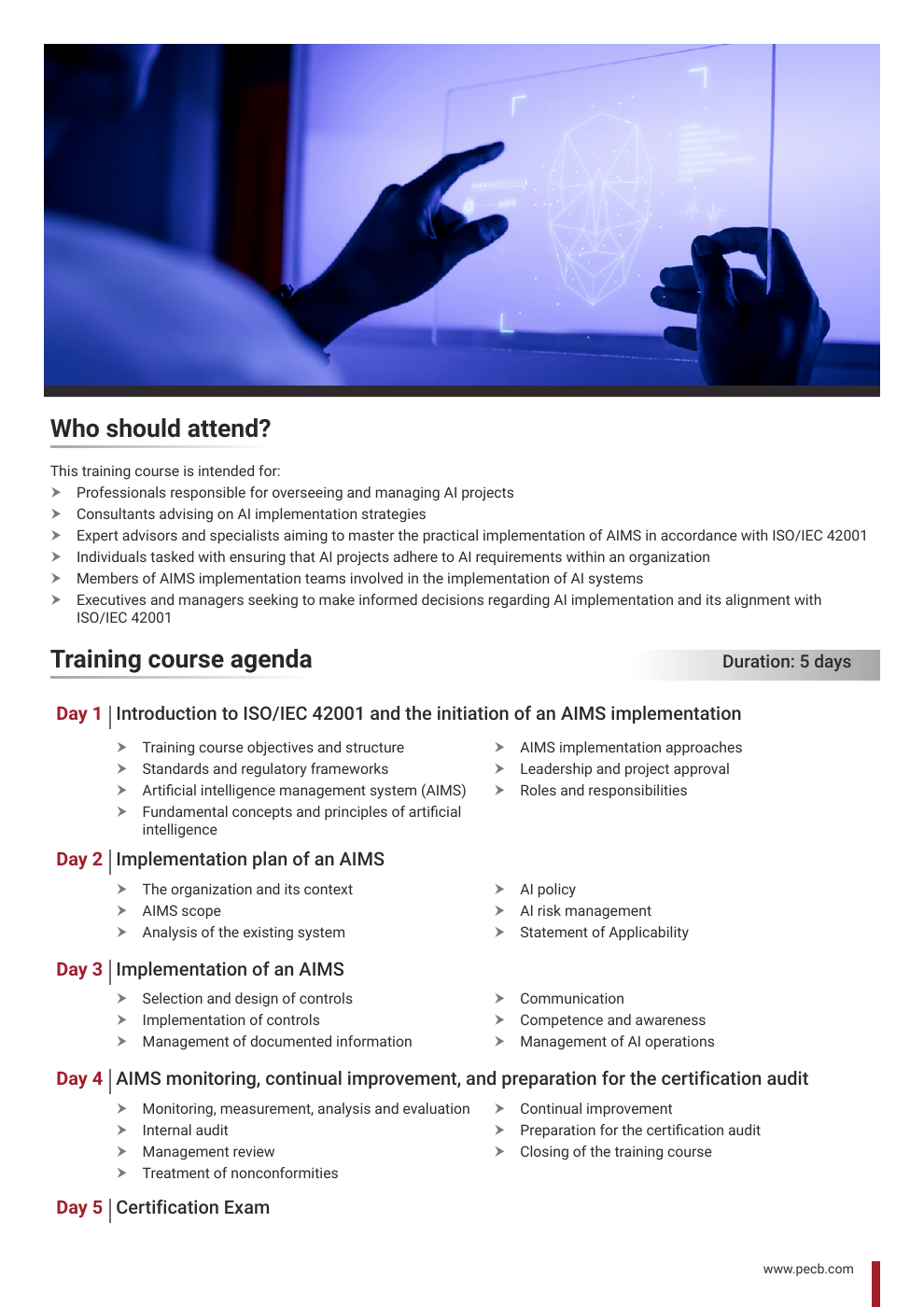
PECB’s Lead Implementer learning path focuses on applying that framework. The provider’s course agenda spans initiation, planning, implementation, monitoring and improvement, and an exam. The credential is distinct from an organization receiving certification: an individual credential indicates that a person has met PECB’s requirements for a professional level, while an organization’s AIMS is assessed separately by a certification body.
It is also not an AI engineering badge. It does not establish that you can train a model, build a retrieval-augmented generation system, tune an inference endpoint, or evaluate model quality. Those are complementary technical skills, not the point of this credential.
Exam scope and assessment
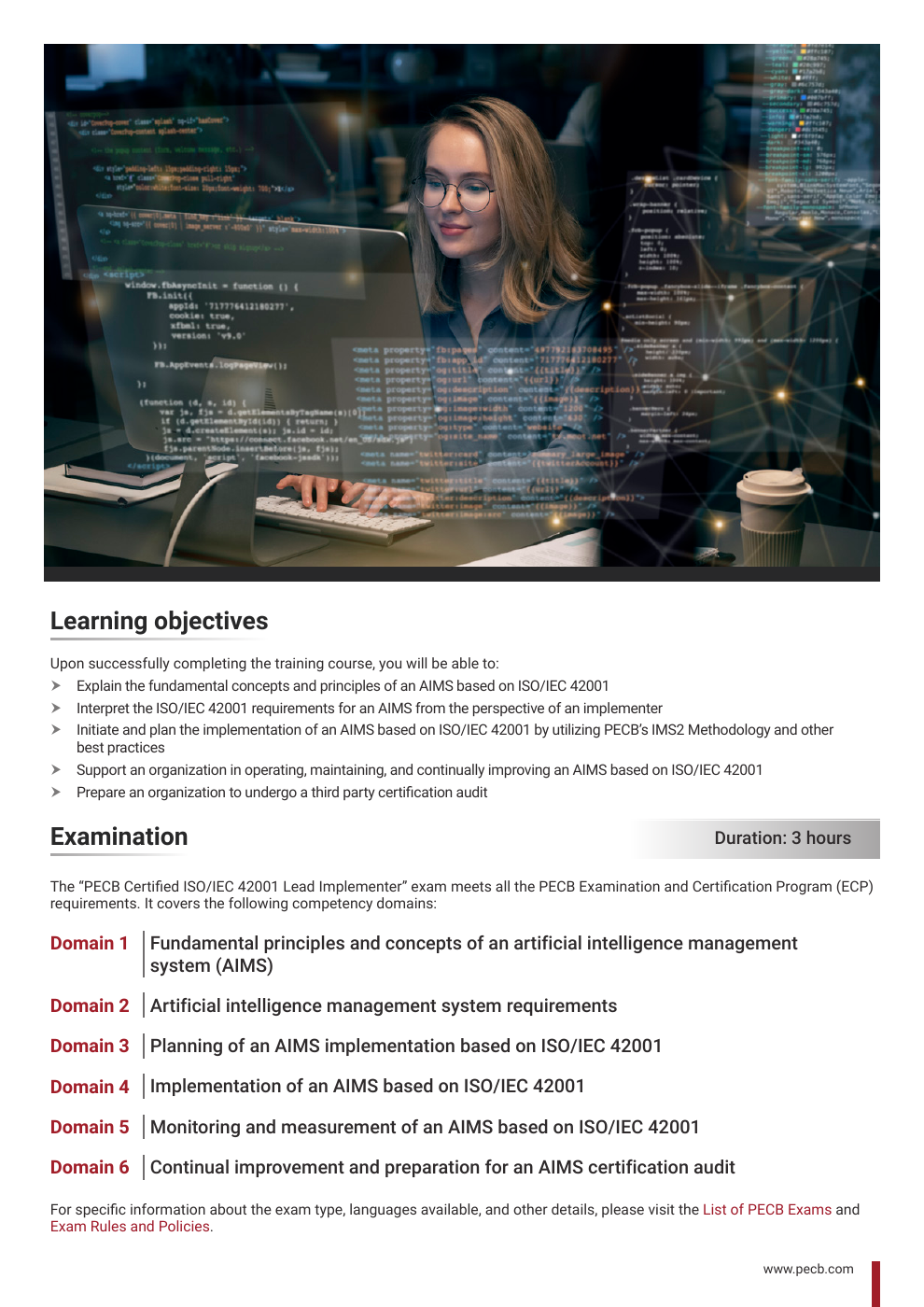
PECB lists a three-hour exam covering six domains:
- Fundamental principles and concepts of an AIMS.
- AIMS requirements.
- Planning an AIMS implementation based on ISO/IEC 42001.
- Implementing an AIMS based on ISO/IEC 42001.
- Monitoring and measuring an AIMS.
- Continual improvement and preparation for an AIMS certification audit.
The official PECB candidate handbook provides detailed exam and certification rules. PECB’s scheme describes an 80-question, three-hour multiple-choice exam and a 70% passing score; confirm the current handbook and exam rules when booking because providers can revise exam policies.
The coverage has a clear implementation lifecycle. Prepare by being able to connect organizational context and AI use cases to scoped controls, documented evidence, risk treatment, monitoring, corrective action, and audit readiness—not by memorizing clause labels alone.
The credential has an experience gate
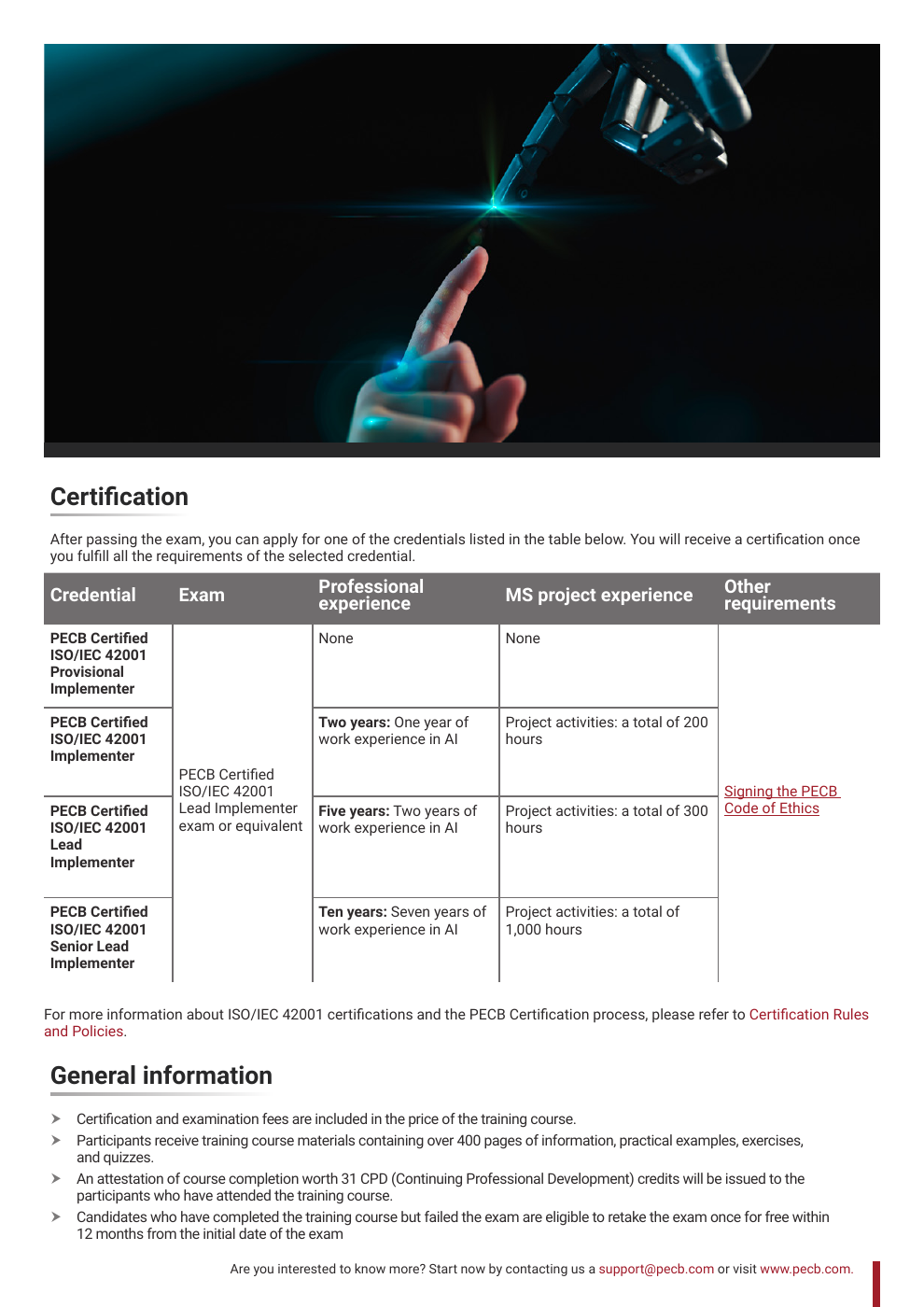
Passing the exam is not the whole Lead Implementer award. PECB’s current credential table distinguishes exam completion from the professional credential level. It lists:
- Provisional Implementer: pass the Lead Implementer exam or equivalent and sign the PECB Code of Ethics; no professional or project experience specified.
- Implementer: two years of professional experience, including at least one year in AI, plus 200 hours of relevant project activities.
- Lead Implementer: five years of professional experience, including at least two years in AI, plus 300 hours of AIMS project activities.
- Senior Lead Implementer: ten years of professional experience, including at least seven years in AI, plus 1,000 hours of project activities.
Requirements can change, and PECB evaluates applications. Read the current official table and certification rules before paying for training or claiming a professional grade. In particular, do not describe yourself as a certified Lead Implementer based only on course attendance or an exam pass if you have not met the stated experience requirements.
For an IT professional who has not yet accumulated qualifying project work, the practical near-term outcome may be training and an exam pass followed by an entry-level credential or continued experience-building—not immediate Lead Implementer status.
Where it connects to real IT work
The framework becomes useful when governance has to meet operational reality. An endpoint, cloud, or security team can contribute evidence such as:
- an inventory of approved AI services, business owners, data types, and intended uses;
- identity, access, tenant configuration, and vendor-risk decisions for AI services;
- change records and approval workflows for AI-enabled features or agents;
- data-handling rules, retention decisions, and documented restrictions on sensitive inputs;
- monitoring for service changes, incidents, user complaints, and policy exceptions;
- incident escalation, corrective actions, and periodic management review;
- documented risk assessments and evidence that chosen controls operate as intended.
These are examples of useful implementation artifacts, not a claim that the exam requires a particular product or technical integration. The course is standards-oriented; candidates should translate the framework to their organization’s actual services, legal obligations, and risk appetite.
How to prepare without turning it into clause memorization
- Read the current PECB candidate handbook and official exam page. Use them as the authority for format, domains, passing rules, and certification applications.
- Study the standard’s management-system structure and vocabulary. Distinguish organization-level requirements from the detailed technical behavior of any one model.
- Choose a bounded AI use case—such as an internal assistant—and map its purpose, stakeholders, data, accountable owners, risks, controls, monitoring, and review cycle.
- Draft a small evidence set: scope statement, policy, risk-treatment record, control evidence, monitoring measures, incident path, and improvement actions.
- Practice scenario reasoning. Be prepared to decide what evidence is missing, who owns the decision, how a risk is treated, and how effectiveness is checked.
- Keep a project log that accurately documents your role, dates, activities, and hours. PECB may require evidence for the level you apply for.
Training can help with guided preparation, but it should not be confused with a substitute for professional experience. Compare authorized course options, total cost, exam inclusion, and current retake rules before enrolling; fees and delivery options can vary.
Who should pursue it?
A good fit: experienced security, risk, compliance, cloud, or IT program professionals who will help establish or operate AI governance processes and can obtain relevant project experience.
A possible fit: IT administrators moving into AI platform governance, if they already have organizational support to participate in an AIMS project and understand that technical operations alone may not meet the experience criteria.
Probably not the best first choice: someone who wants to build models or AI applications, or a generalist looking for a broad entry-level AI fundamentals credential. Start with hands-on engineering or foundational training that directly matches the target role, then revisit ISO/IEC 42001 when governance responsibilities become concrete.
Bottom line
PECB ISO/IEC 42001 Lead Implementer is a focused professional credential for implementing an AI management system—not a general AI or machine-learning certificate. Its strongest value is the combination of a lifecycle-oriented exam scope and a framework for turning responsible-AI commitments into owned, documented, reviewable processes.
The experience thresholds materially affect its return on investment. Before enrolling, confirm that you can meet the requested AI experience and project-hour evidence, and that your target role genuinely needs AIMS implementation capability. If so, pair preparation with a real, well-scoped governance project; that evidence will matter more than the badge alone.
Official sources
- PECB — ISO/IEC 42001 Lead Implementer
- PECB — ISO/IEC 42001 Lead Implementer candidate handbook
- PECB — ISO/IEC 42001 Lead Implementer brochure (PDF)
- ISO — ISO/IEC 42001:2023 AI management systems
Research checked October 3, 2026. Always confirm current provider requirements before booking an exam or applying for a credential.